Tag Archives: online learning

Google’s News LMS (Apps for Education)

A colleague at work alerted me to the news that Google has a new free LMS for schools. Google Classroom will be the new tool that adds a Learning Management System to Google Apps for Education.

Campus Technology has a brief piece of news here, and Google has a page where you can sign up for an invite.

There is a certain degree of déjà vu all over again with the news. Google has released, or announced, similar initiatives in the past:

Google is known for discontinuing great products and services (such as Lively, Wave, Google Reader), seemingly because a product manager leaves or moves on to another project. Whilst being a free option, there may be some risk in committing to the new Google Classroom.

CourseMaster, edX, and my LMS Wishlists

Coursemaster

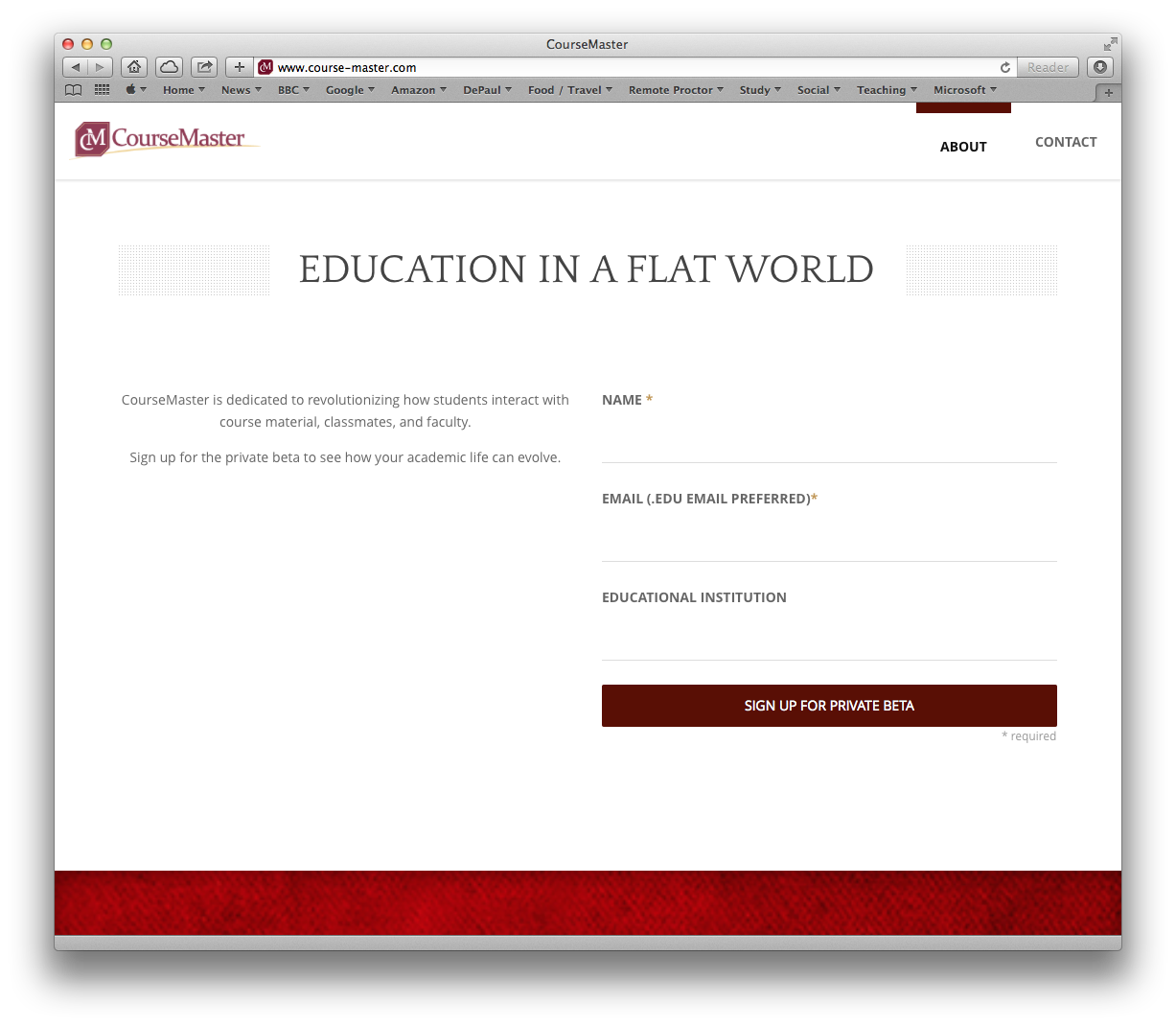
On Friday, I had the chance to talk with Daniel McKelvey (VP of Business Development at CourseMaster).  CourseMaster is positioning itself as an edX service provider. edX is open source, so those with both the technical resources and the inclination can download and install their own instance of the software. Alternatively, organizations can turn to a third party like CourseMaster.

In our conversation, Daniel positioned CourseMaster as having three distinct advantages (i.e. elements added by the company):

  1. LMS core (branded, fully serviced and supported)
  2. Faculty dashboard
  3. Social collaboration and gamification

Support is for both faculty and students.

The business model is based on users (defined as interacting with 20% of course content) and duration of the course.

This looks interesting, and I intend to investigate further. Working on getting some colleagues to collaborate on a pilot.

The faculty dashboard and collaboration modules are what I am most interested in. Currently, Learning Management Systems are still pretty much Web 1.0. Most educators use the LMS as a publishing platform, and student interaction gravitates towards discussion, quizzes, and the uploading of files. Hopefully we will soon see Learning Management Systems approach Web 2.0 interactivity.

For example, services like Doodle allow me to quickly (and automatically) negotiate the best time for a group of colleagues to meet. Imagine if a LMS allowed for that type of automated decision making for the composition of student groups (based upon skillset, timezone preference, and/or project preference).  Affordances like this are what is needed in a LMS, particularly as we see increasing time demands on both students and faculty. I still have yet to see true collaboration tools built into the leading LMS providers that come close to the power of Google Docs, Skype, or Facebook. WordPress is a model that I would like to see Learning Management Systems follow here, where you could browse for plugins that add the collaboration functionality you need (that being said, WordPress  can be used as a LMS).

Introduction To Flipping The Classroom

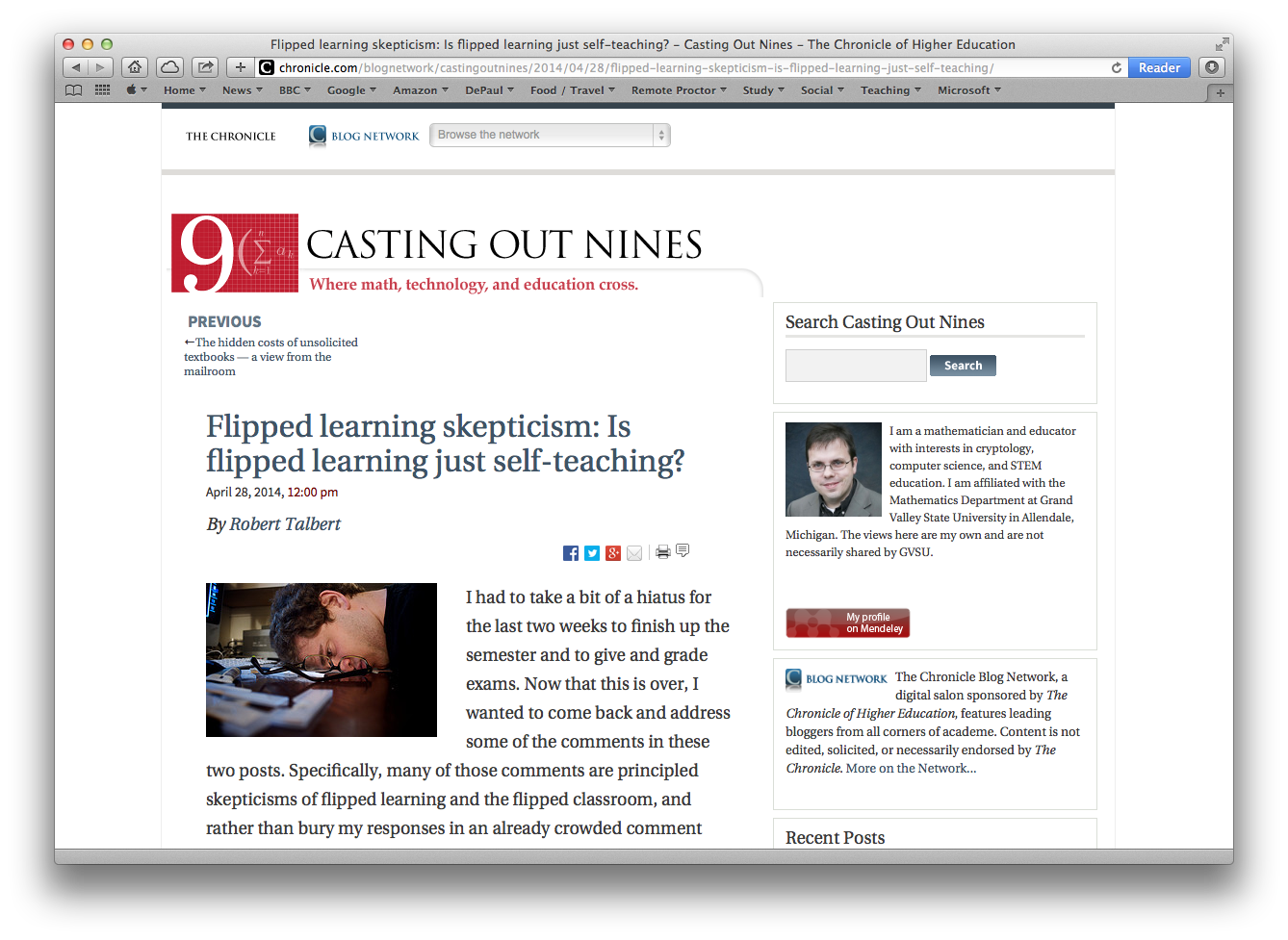
Flipped learning skepticism: Is flipped learning just self-teaching?

A colleague at work shared a great article from the Chronicle of Higher Education on flipping the classroom (Flipped learning skepticism: Is flipped learning just self-teaching?).

The article (by Robert Talbert) provides a well-articlated reason to teach in a flipped manner, and suggest ways to use the in-class time effectively (think coaching). If looking for a good introduction/example to share, this is a contender.

Online Learning: Key Design Principles

Key Design Principles

Key Design Principles

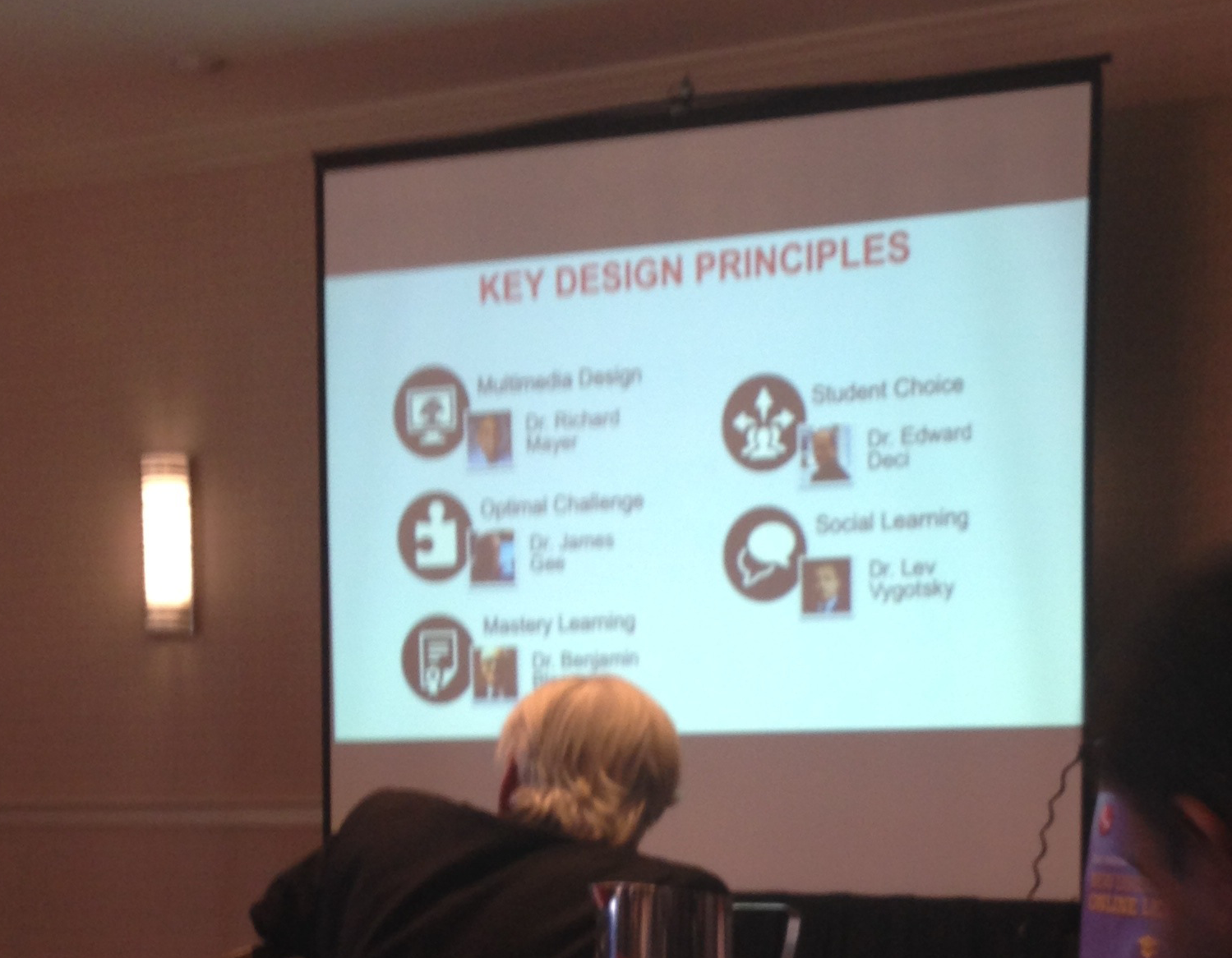
Hank Bowman (Chief Sales and Marketing Office, Adapt Courseware) recently gave a presentation at the New Directions in Online Learning conference. His presentation was focussed on introducing Adapt Courseware to the audience, and the underlying design philosophy of the company. One particular slide caught my eye, and this was the five gurus they looked to for Key Design Principles. This is a particularly useful cheat sheet for anyone in the field of online learning and instructional design:

Key Design Principles


I have added links for those interested in exploring further.

Ten Years of Tracking Online Education in the United States

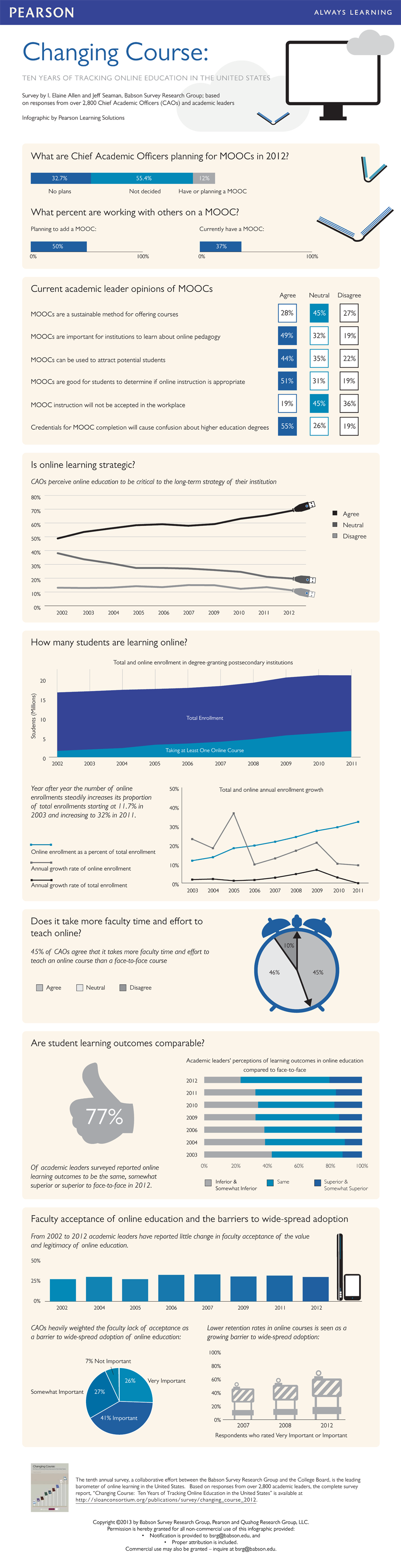
Pearson has a published a very useful report on “Ten Years of Tracking Online Education in the United States.” The accompanying infographic is shared below. The complete report is available at:

http://sloanconsortium.org/publications/survey/changing_course_2012 

(and yes, they do talk about MOOCs in the report)

Ten Years of Tracking Online Education in the United States

Ten Years of Tracking Online Education in the United States

My MOOC Life (So Far): Part 4 – Course Cancelled

The Coursera MOOC I was taking (Fundamentals of Online Education) was recently cancelled. The reasons behind this (and the way in which the course was cancelled) have been instructive. I believe that this particular moment will feature heavily in future analysis of the MOOC movement.

On the 2nd February, I received this short email message from the instructor:

We want all students to have the highest quality learning experience. For this reason, we are temporarily suspending the “Fundamentals of Online Education: Planning and Application” course in order to make improvements. We apologize for any inconvenience that this may cause. We will inform you when the course will be reoffered.

Then I received this email update the next day:

Dear FOE students,

We were inspired to see the number of people who expressed an interest in seeing the class resume. There were some choices made in the initial design of the class that didn’t work out as well as we’d hoped. We are working to address these issues, and are reopening the discussion forums so that we can get feedback on how the class can be improved when it relaunches.

Thank you for your patience as we work to provide you with a great learning experience in the next version.

The FOE Course Staff

Fundamentals of Online Education: Planning and Application Course Team

I don’t believe either of those emails were honest. The messages did not accept the three major problems that this particular course had:

  1. The course was still under construction at time of launch.
  2. The group model was both poorly designed and implemented.
  3. There was no Quality Assurance in place before the course was offered.

The course was still under construction at time of launch

The first issue was inexcusable, particularly given the subject matter of the course. One of the fundamental tenets of good online course design is to have everything built before a course goes live. This does not preclude alterations and improvements (where justified) as a course is being taught, but this particular course still had “insert text here” content in the “About” pages. Going forward, Coursera needs to institute processes that ensure a course is ready before it launches.

The group model was both poorly designed and implemented

The second issue was interesting on several levels. The stated reason for assigning groups for students in the course was:

to make the discussions more manageable and to allow you to form networks with people in your own field and even with others not in your field. The idea was to create a world wide network of people who can help each other and to start building a world wide online learning community that will provide support and help.

However, MOOCs exhibit a significant attrition rate. In the first Coursera course I took these statistics were shared:

  • Number of students signed up: 45572
  • Number of students completing week 1: 1164
  • Number of students who took the Final: 5401
  • Number of certificates: 4595

To my mind, group membership would be significantly reduced by the end of the course (unless being part of the group successfully induced the majority of students to complete the course). I did not see this particular group model working. The instructor’s point about MOOC discussion being unmanageable is correct, and this is something that needs to be fixed, but the group method she implemented was not a viable solution.

Additionally, the methods in which students added themselves to groups were flawed. Initially this was through Google Docs, which does not scale to thousands of students (and resulted in records being deleted either inadvertently or to cause trouble). The later method was via discussion boards, in a way that was both inefficient and confusing. In neither option was there a way for students or Coursera to plan the composition of a group based upon any criteria (i.e. mixed skill-set,  learning style, location, primary language, etc.). Hopefully the instructional designers and developers at Coursera will look for a method in which the course technology can automatically assign groups in an intelligent fashion. This would be an opportunity to run some very interesting and productive research.

There was no Quality Assurance in place before the course was offered.

Lastly, I did not see any indication of Quality Assurance being run in this course. If there had been a process in place that that reviewed the course before launch, then this would have caught that fact that the course was still under construction, and this should have also highlighted problems with the groups model. This is a major issue for Coursera to address. Oversight needs to be in place to demonstrate that a MOOC offers a superlative educational experience to students. The publishing industry relies on editors, proof-readers, legal review, designers, and peer assessment to ensure that what reaches the reader is a quality product. A MOOC should be have the same level of oversight as a good publishing house.

UPDATE: Interesting commentary from Slate on the “course meltdown.” Worth searching on Twitter for #foemooc
 

My MOOC Life (So Far): Part 3 – Fundamentals of Online Education

I started my most recent MOOC today. This was another offering from Coursera, and focused on an area that fits into my work life very well. The course (Fundamentals of Online Education: Planning and Application) had a slightly rocky start, students were meant to add themselves to groups of 21 via a Google spreadsheet, but this resulted in inadvertent deletion of groups and a crashed server. The discussion boards were later used for students to add themselves to groups. I am in “Start LL” (I think).

I began the week by penning a quick introductory post, and then searched via a couple of keywords to see if there was anyone else in the course from work or Chicago. The introductory discussions are where I think Coursera could make a few improvements – it would be nice to apply a global profile more successfully for each subsequent course, and to create a groups/friends options which would allow for students to find contacts in each  new course.

My next step was to complete two learning styles questionnaires:

  1. VARK Learning Style Questionnaire
  2. Index of Learning Styles Questionnaire (ILS)

According to the VARK Questionnaire, I have a mild Read/Write learning preference:

  • Visual: 9
  • Aural: 5
  • Read/Write: 14
  • Kinesthetic: 8

Which suggests that I follow these strategies to study more effectively.

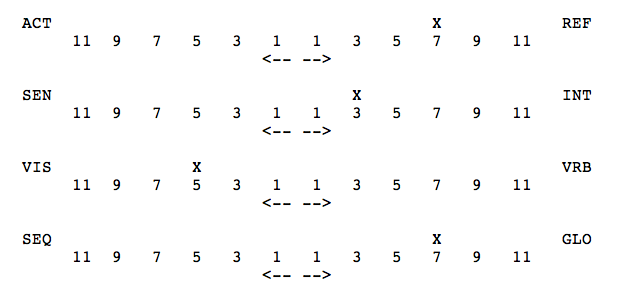
The results for the Index of Learning Styles Questionnaire (ILS) were as follows:

Learning Style Results

Learning Style Results

This suggests that I have largely moderate preferences for these learning styles:

  • Reflective (7)
  • Intuitive (3)
  • Visual (5)
  • Global (7)

Both these questionnaires were useful and interesting, and I think I will use them in the classes I teach. The course also provided a link to the “Are You Ready For An Online Class” page at Georgia Tech. It might be worthwhile coming up with a similar page more focussed on being in MOOC….

The course designers provided a background survey, which I completed. A couple of questions stood out for me:

Which one of the following component(s) do you think is important in an online course?

  • The navigation of the course website
  • The work load
  • Timely feedback from the instructor
  • Small group discussions
  • Group Projects
  • Other

Somewhat tellingly, assessment of learning was not a stated option.

If a 24 hour, 7 day a week help center staffed by qualified teaching assistants were available for this course, would you use it if you needed help?

I assume that this option would more more fully lead to a business model for Coursera.

Week 1

Week 1

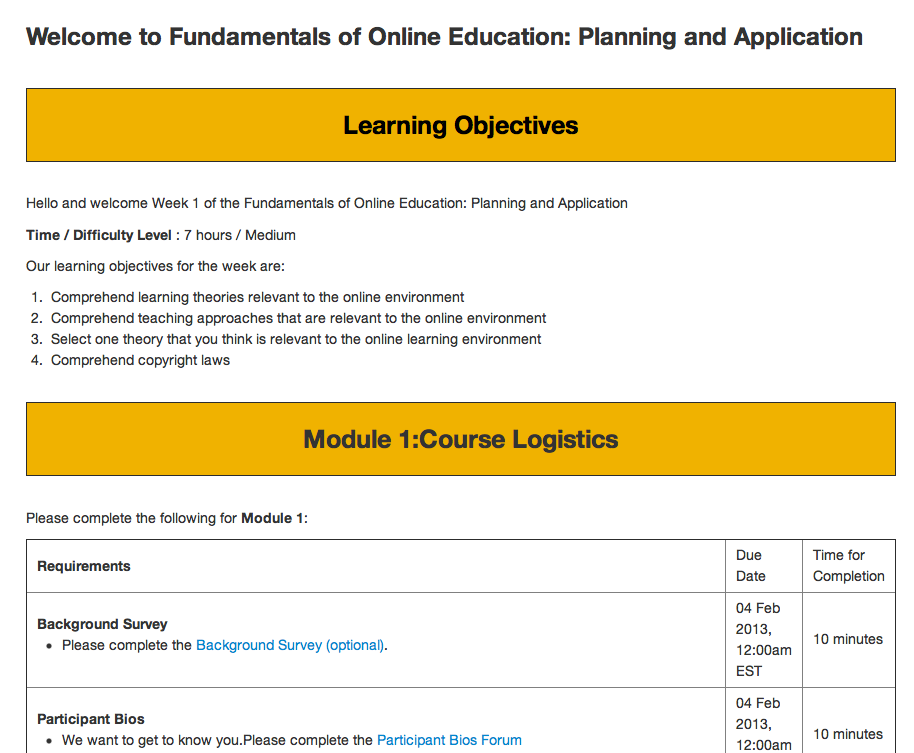
Each Coursera course has exhibited a different personality, and the navigation for this course is very functional (but a tad ugly). The “Week 1” tab provides a table of the various requirements, due dates, and time for completion. This was a nice touch, although the introductory videos indicate that the course is fluid and subject to change.

Moving forward, I will be careful to temper my notes here and prevent the posting of anything that could be considered plagiarism or breaking the academic standards of Coursera.

DEPD 0330 Reflection

I an currently taking an online course (DEPD 0330 Learning in the Mobile Age) via  the University of Wisconsin-Madison Distance Education Professional Development Program, and this is my time to reflect.

Moodle Course on iPhone

Moodle Course on iPhone

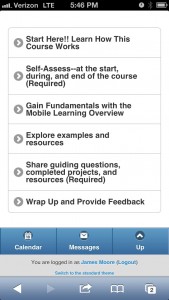
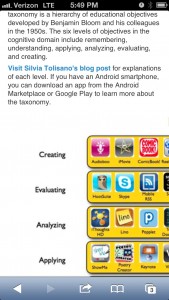
I have consciously attempted to study on a plethora of mobile devices (iPhone 5, iPad 3, Nokia N900, and Apple MacBook Air). The experience has been pleasant, and I have been impressed by how well the Moodle site has rendered on mobile devices. In some ways the navigational process has been more pleasant on an iPhone, where much of the structure has been abstracted. The only times I have wanted to return to using a laptop (which is still a mobile device) have been where images were difficult to view on the phone, or now, when I needed to type something up that was more than a few paragraphs in length.

Larger Images Did Not Work So Well On A Mobile Device

Larger Images Did Not Work So Well On A Mobile Device

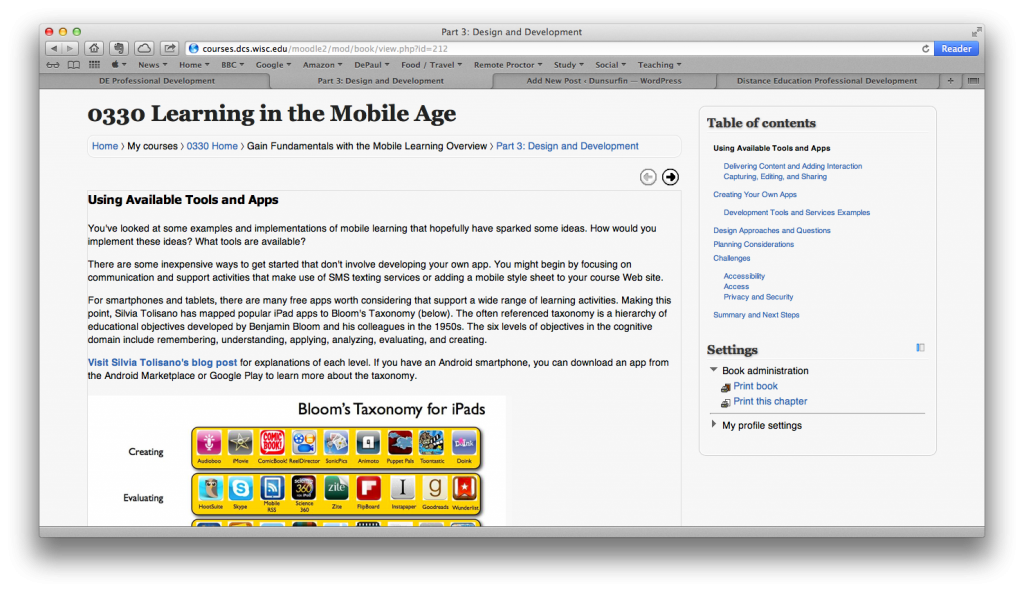
The resources that have been particularly useful to me in this course were in Part 3 (Design and Development), where a list of applications and ideas were listed for mobile student activity. Some of these I was already using, but others will be explored. These resources will be used in the classes I teach, and shared with my colleagues at work.

Part 3: Design and Development

Part 3: Design and Development

I liked how various “chapters” of the courses could be collated and printed as a PDF. This will allow me to explore these resources after the course had finished, but my ideal situation would have been to save everything as an ebook (epub or ibook).

The course has introduced the concept of a guiding question, defined here as:

“A guiding question is the fundamental query that directs the search for understanding.” (Traver, 1998, p. 70)

My guiding question is one I have pondered for a while – how should one communicate with online students? Essentially I am looking for the ideal delivery platform for instructional materials that lasts beyond the course. A Learning Management System is a powerful platform, but once a course is over students no longer have access to the contents. Communicating over the Internet is efficient and extensible, but students do not always have continuous access to the Internet. I need something that works beyond these limitations.

I think my guiding question is still relevant based upon the ideas and material I have encountered in the course.  In some ways this has become more relevant, as during the course I experienced times in which I wanted to study but did not have Internet access. An ideal platform for study would have (perhaps) been something analogous to a service like EverNote, which provides a local copy of resources on digital device, but syncs when connected to the Internet.

The guiding question will continue beyond the life of the course, but the course has introduced new tools and perspectives that will help me approach a workable solution to the problem.