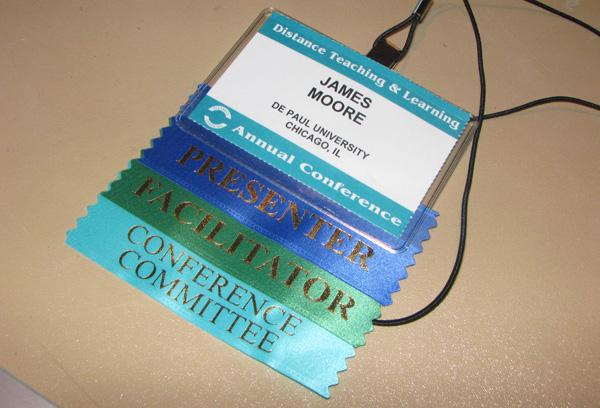
A week ago I spent three extremely rewarding days at the Distance Teaching and Learning conference in Madison (full disclosure, I am on the planning committee). It has taken a few days to put my notes and thoughts in order, and here they are.
Wednesday

Madison, 2012
Early morning saw me boarding the Megabus to Madison. The cost of the trip was shockingly low – just five dollars. I spend more travelling to and from work on the El each day.
I arrived in Madison in time to meet with Dawn Drake and finalize our presentation for one of the Communities of Practice sessions that afternoon (on Management and Administration). I enjoyed discussing the topic with the folks there.
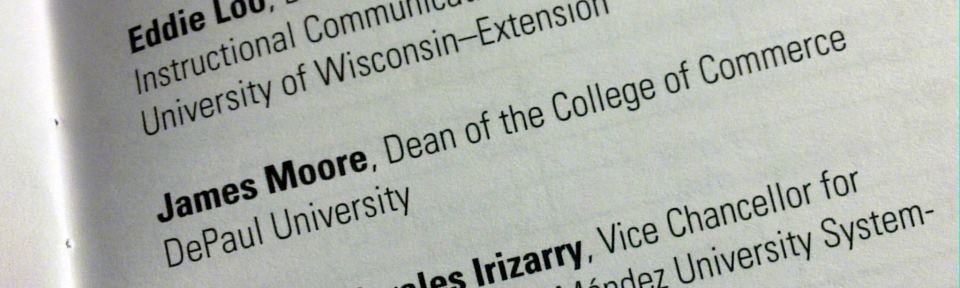
I was slightly shocked to discover an inadvertent promotion on page 33 of the conference brochure (I am not Dean of the College of Commerce).
Thursday
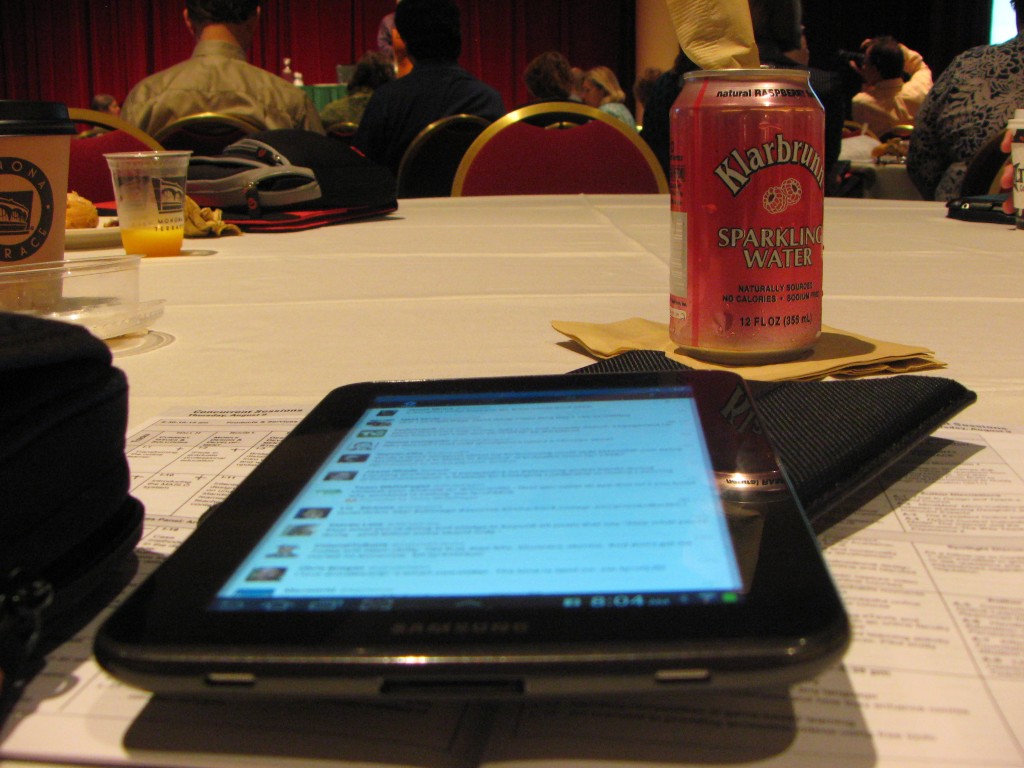
The trending topics of the conference from my perspective were mobile learning and MOOCs. Previous conferences had been abuzz with discussion on Second Life, Google Wave, and Social Media. The focus on mobile and MOOCs seemed to me to be more pragmatic. Mobile communication was ever present during the conference – the effective use of Twitter heightened my enjoyment of the sessions (and muted any dissatisfaction with particular presenters). The keynote from James Zull was not the strongest part of the conference. Zull is a far better researcher than large-venue presenter. His premise did make me think, and his presentation style gave me plenty of time to tweet and retweet with others in the room. This was particularly refreshing, with a vigorous discussion and commentary taking place along the back channels.
Norma Scagnoli’s and Seung won Hong’s presentation on “iPads is graduate professional education” was enjoyable. Norma admitted that the use of iPads at the University of Illinois in the Management program was flawed, with students and faculty not knowing initially whether they owned the iPads or had to return them. I hope they are able to repeat the experiment and train students and faculty on effective use, rather than discover what happens organically. I wanted to know whether students were able to use etextbooks on the iPad effectively in a classroom situation (I have observed that students are able to make notes and refer to material more rapidly in printed textbooks).
Ray Schroeder’s “eduMOOC: Open online learning without limits” presentation was packed, and worked as an iceberg presentation – there was much more material below the surface. I will have to return to his site and explore more:
https://sites.google.com/site/edumooc/
Ray Schoeders talk about MOOCs was probably the most productive session for me.
Scott Schopieray’s “One Week, One Course (OWOC): A rapid prototyping concept for courses” contained a little smoke and mirrors – the courses were not completed in a week, but the idea is intriguing. The design of the rapid prototyping model was clever, and effectively implemented. I am tempted to see if this is an idea that can be implemented at work.
The “iPad apps for utility and learning” was not a presentation that I should have attended. Unfortunately I was in the front row as the presentation started, and when I realized my mistake it was too late to leave….
I did not see much at the vendor presentations that was new and exciting, but I am taken with the idea of Camtasia Relay. This may be an effective way way to scale classroom recording and adhoc lecture capture. This is something I will look later.
Thursday evening ended with a delicious meal with some of my colleagues from DePaul at Harvest, a little restaurant with a great view of the capitol.
Friday

The Capitol in Madison, and a statue of Hans Cristian Heg
Friday morning began with a fun follow-up discussion of Administration and management. I then attended Dean Blackstock’s and James Mudie’s presentation on “Streaming high quality mobile video: A conversation and some code!” Dean and James developed a great solution to automatically serve up the right type of video to mobile users. Not a solution that I need at the moment, but fun and interesting.
I next attended Johanna Dvorak’s and Laura Pedrick’s presentation on “Developing a comprehensive campus-wide online student services initiative.” What they presented was a work in progress, but the policies applied to assemble the stakeholders and determine what needed to be done are ones I will gladly borrow.
The last concurrent session of the day was “Using mobile technology in faculty development and training.” This was a Rena Palloff and Keith Pratt session, with George Engel providing most of the information I was interested in. Their handout is on the web, and can be found here:
http://mobilefieldworkshop.wikispaces.com/file/view/Faculty+Training+Using+Mobile+Technology.pdf
What I didn’t see answered was how mobile devices constrain focus. Anecdotally, I have noticed that those that I correspond with on mobile devices frequently cannot process multiple concepts in the same email. This topic is deserving of a conference presentation (and research).
The conference ended with a keynote from Judy Brown. Already I am looking forward to next year.