Category Archives: Internet

28th Annual Conference on Distance Teaching & Learning

Conference ID

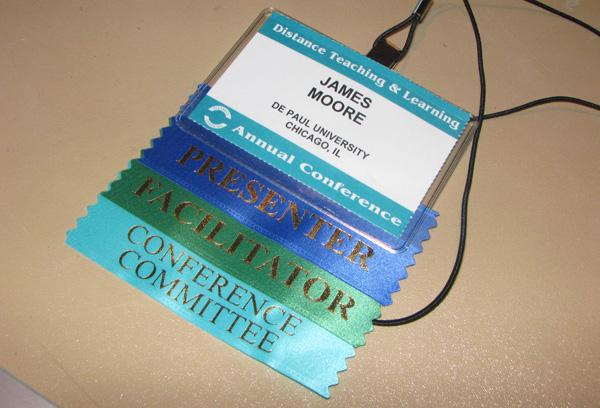
A week ago I spent three extremely rewarding days at the Distance Teaching and Learning conference in Madison (full disclosure, I am on the planning committee). It has taken a few days to put my notes and thoughts in order, and here they are.

Wednesday

Madison, 2012

Madison, 2012

Early morning saw me boarding the Megabus to Madison. The cost of the trip was shockingly low – just five dollars. I spend more travelling to and from work on the El each day.

I arrived in Madison in time to meet with Dawn Drake and finalize our presentation for one of the Communities of Practice sessions that afternoon (on Management and Administration). I enjoyed discussing the topic with the folks there.

Promotion

I was slightly shocked to discover an inadvertent promotion on page 33 of the conference brochure (I am not Dean of the College of Commerce).

Thursday

Madison Conference 2012

The trending topics of the conference from my perspective were mobile learning and MOOCs. Previous conferences had been abuzz with discussion on Second Life, Google Wave, and Social Media. The focus on mobile and MOOCs seemed to me to be more pragmatic. Mobile communication was ever present during the conference – the effective use of Twitter heightened my enjoyment of the sessions (and muted any dissatisfaction with particular presenters). 

The keynote from James Zull was not the strongest part of the conference. Zull is a far better researcher than large-venue presenter. His premise did make me think, and his presentation style gave me plenty of time to tweet and retweet with others in the room. This was particularly refreshing, with a vigorous discussion and commentary taking place along the back channels.

Norma Scagnoli’s and Seung won Hong’s presentation on “iPads is graduate professional education” was enjoyable. Norma admitted that the use of iPads at the University of Illinois in the Management program was flawed, with students and faculty not knowing initially whether they owned the iPads or had to return them. I hope they are able to repeat the experiment and train students and faculty on effective use, rather than discover what happens organically. I wanted to know whether students were able to use etextbooks on the iPad effectively in a classroom situation (I have observed that students are able to make notes and refer to material more rapidly in printed textbooks).

Ray Schroeder’s “eduMOOC: Open online learning without limits” presentation was packed, and worked as an iceberg presentation – there was much more material below the surface. I will have to return to his site and explore more:

https://sites.google.com/site/edumooc/ 


Ray Schoeders talk about MOOCs was probably the most productive session for me.

Scott Schopieray’s “One Week, One Course (OWOC): A rapid prototyping concept for courses” contained a little smoke and mirrors – the courses were not completed in a week, but the idea is intriguing. The design of the rapid prototyping model was clever, and effectively implemented. I am tempted to see if this is an idea that can be implemented at work.

The “iPad apps for utility and learning” was not a presentation that I should have attended. Unfortunately I was in the front row as the presentation started, and when I realized my mistake it was too late to leave….

I did not see much at the vendor presentations that was new and exciting, but I am taken with the idea of Camtasia Relay. This may be an effective way way to scale classroom recording and adhoc lecture capture. This is something I will look later.

Thursday evening ended with a delicious meal with some of my colleagues from DePaul at Harvest, a little restaurant with a great view of the capitol.

Friday

The Capitol in Madison, and a statue of Hans Cristian Heg

The Capitol in Madison, and a statue of Hans Cristian Heg

Friday morning began with a fun follow-up discussion of Administration and management. I then attended Dean Blackstock’s and James Mudie’s presentation on “Streaming high quality mobile video: A conversation and some code!” Dean and James developed a great solution to automatically serve up the right type of video to mobile users. Not a solution that I need at the moment, but fun and interesting.

I next attended Johanna Dvorak’s and Laura Pedrick’s presentation on “Developing a comprehensive campus-wide online student services initiative.” What they presented was a work in progress, but the policies applied to assemble the stakeholders and determine what needed to be done are ones I will gladly borrow.

The last concurrent session of the day was “Using mobile technology in faculty development and training.” This was a Rena Palloff and Keith Pratt session, with George Engel providing most of the information I was interested in. Their handout is on the web, and can be found here:

http://mobilefieldworkshop.wikispaces.com/file/view/Faculty+Training+Using+Mobile+Technology.pdf

What I didn’t see answered was how mobile devices constrain focus. Anecdotally, I have noticed that those that I correspond with on mobile devices frequently cannot process multiple concepts in the same email. This topic is deserving of a conference presentation (and research).

The conference ended with a keynote from Judy Brown. Already I am looking forward to next year.
My MOOC Life (So Far)

I have cautiously been circling MOOCs (Massive Open Online Courses) recently. The educational media has been all over the trend to create an appropriate platform and populate with courses, and “mainstream media” has started to pay attention too. My fear is that MOOCs will be viewed as a silver bullet to the plethora of problems that education in general faces. Most likely there will be a MOOC bubble. 
However, MOOCs are moving education in the right direction. Faculty, instructional designers, software engineers, and students are generously donating their time and attention to craft courses and reusable learning objects that are intended to be easily understood and utilized in a scalable fashion. Things could of course become too commoditized and homogenous, but MOOCs are starting to deliver the promise that opencourseware failed to deliver.

Anyway, my firm belief is that you only truly learn from doing (and making mistakes), so I signed up for some MOOCs. 

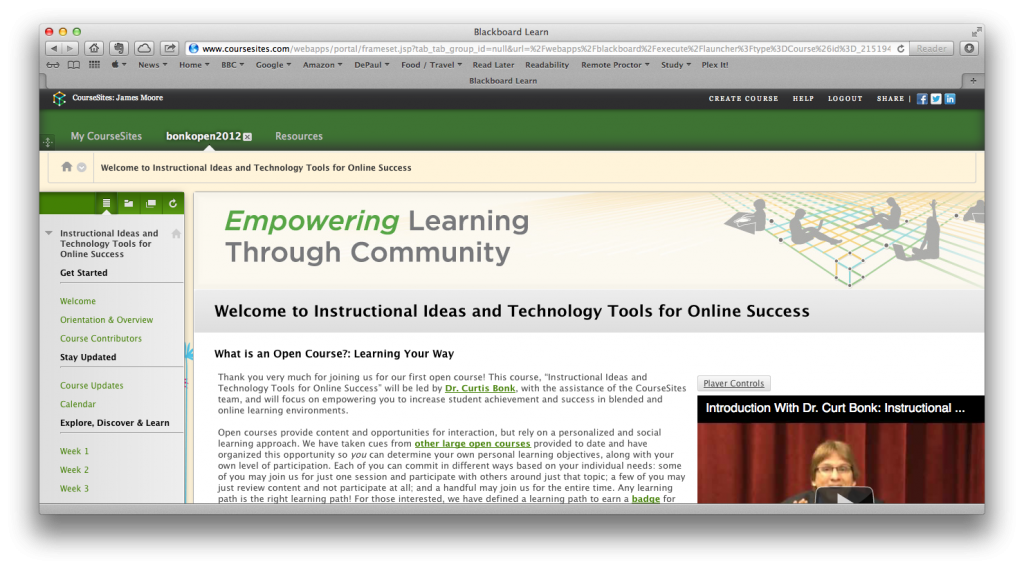
I started with Instructional Ideas and Technology Tools for Online Success. Here I really appreciated and enjoyed the content (from Curt Bonk), but met some frustration with the delivery system. In working through the material I felt that my view that Desire2Learn is a superior LMS to Blackboard was validated. I felt that Blackboard constrained navigation and communication. I felt that Blackboard was more of a document repository than a system that facilitated teaching and Learning.

Instructional Ideas and Technology Tools for Online Success

Instructional Ideas and Technology Tools for Online Success

The course had an accelerated schedule, a five-week duration rather than eleven weeks or longer. This was to be my undoing as I got really, really ill twice during the course. I lost two weeks, and with other commitments I could not catch up. However, the course is still open, and I will endeavor to finish all of the assignments. The content and readings in the course were very helpful. I also made some new contacts via Twitter and Google+ along the way.

Power Searching With Google

Power Searching With Google

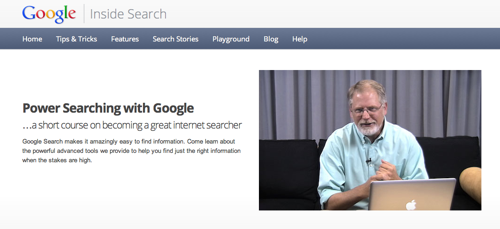
My next MOOC was Google’s “Power Searching With Google.” Google is a company that I like and admire, but it sometimes frustrates me immensely. My frustration in this situation was that the course was unnecessarily ugly. The content, videos, transcripts and exercises were great, but the aesthetic was like an out-of-town factory store -a functional big box that was effective and efficient, but depressing to view. Google’s relentlessly puritan view of engineered effectiveness depresses me. I wish that the company would sometimes make their products look beautiful.

As with many other MOOCs, entering into the discussion area had a tendency to be overwhelming – just keeping track of the conversations was impossible. However, judicious use of search and tags was of use.

Internet History, Technology, and Security

Internet History, Technology, and Security

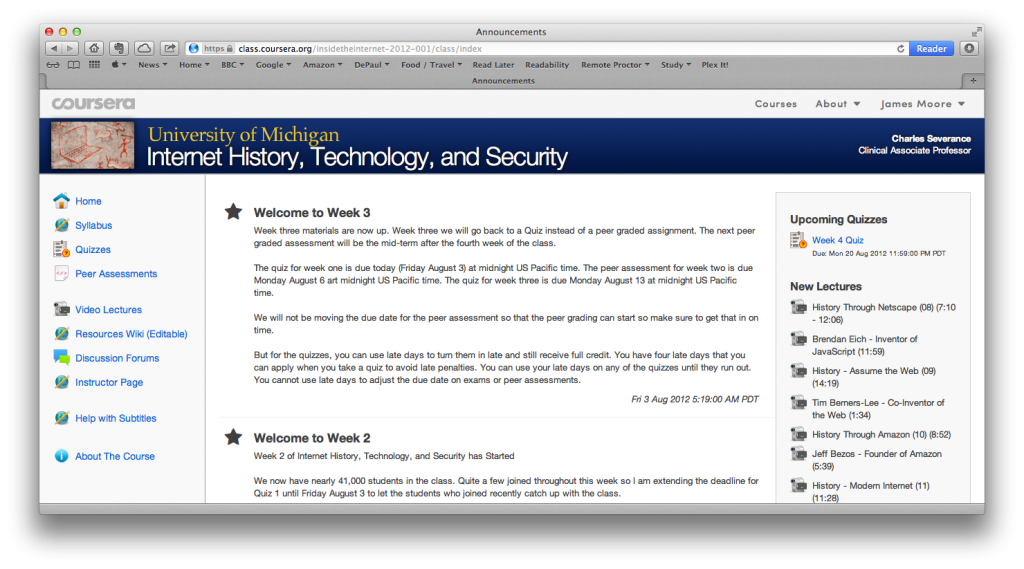
My current MOOC is Coursera’sInternet History, Technology, and Security,” taught by Charles Severance (@drchuck). This is a seven-week course, one in which I arrived late (but not too late). This is a course in which the professor is (by his own admission) inventing along the way, but the structure and material works very well. I have not taken any other Coursera courses, so I don’t know if the instructional design of this course is used in other Coursera courses, but here are a few of the things that have impressed me:

  • The LMS used supports the vast number of students exceedingly well. Video is streamed  and downloaded without a hitch. The navigational scheme is well designed, I have not experienced any disorientation looking for materials.
  • Video is available in both streaming and downloadable versions.
  • Video is generally short, and has embedded quizzes.
  • Students are collaborating on providing transcripts (in multiple languages).
  • The course looks nice. This might sound like a trivial statement, but many online courses are ugly. A pleasant environment is, to my mind, helpful in learning.
  • There are physical office hours. The instructor is travelling around the U.S., and posts office hours for various coffee shops along the way. This is an excellent way for students to actually get to meet each other and their instructor. Luckily Chicago was one of the destinations, and I got to participate.
Cousera Office Hours

Cousera Office Hours

Like other MOOCS there is the inherent issue of assessing learning. So far there have been two strategies employed:

  1.  Automatically graded quizzes. Ten questions are posed for each assessment, which are based on the week’s materials. The questions are drawn randomly from a larger pool of questions, and students can take the quiz multiple times (highest score is preserved). However, students have to wait ten minutes after taking a quiz to retake.
  2. Peer assessment. So far there has been one written assignment. After submitting the written assignment, students are provided with five assignments to grade via a structured rubric. The rubric is largely binary, which simplifies grading. Students are able to provide written feedback and suggestions to their peers. The system works well. There has been at least one instance of a student plagiarizing extensively from Wikipedia – I am interested to see if a plagiarism detection system (like Turn-it-In) could be added.
Next and Continue

Next and Continue

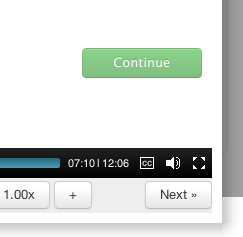
There is one minor flaw that I have encountered in the MOOC, and that is the “Continue” and “Next” buttons in the videos. The videos have embedded quizzes – these pause the video and present the student with questions. After successfully answering the question the student can proceed by clicking on “Continue.” However, the “Continue” button is very close to the “Next” button…. The “Next” button is part of the video player, and Fits Law being what it is, I have a tendency to click on this rather than “Continue.” This results in me navigating to the next video in that week’s content, rather than continuing through the video that I was watching. I silently curse and backtrack when this happens (I think others have encountered the same issue, so the “Continue” button is in green).

Charles Severance has thoughtfully provided some statistics on student participation. I found this information to be very interesting:

  • Enrolled: 42935
  • Watched at least one lecture: 22651
  • Took Quiz 1: 11402
  • Submitted the Peer-Graded Assignment: 5808

My views on MOOCs at the moment are that they are here to stay. A business model has not been established, but I am sure one will evolve. I don’t think traditional universities are going to be hurt by MOOCs, but this may hurt the publishing industry. A MOOC is essentially an interactive book, so why buy a textbook or manual when you can take a MOOC that covers the topic for free?

Annual Conference on Distance Teaching & Learning Hashtags

I will be attending the Annual Conference on Distance Teaching & Learning that takes place in early August. Very much looking forward to it. The conference organizers have prepared a list of suggested hashtags:

  • General: #dtl12
  • Keynotes: #dtlkey
  • Forums: #dtlforums
  • Administration & management: #dtladmin
  • International: #dtlglobal

Will be interesting to see how these are used on Twitter, Foursquare, Instagram, etc.

Power Searching with Google

Power Searching With Google

Power Searching With Google

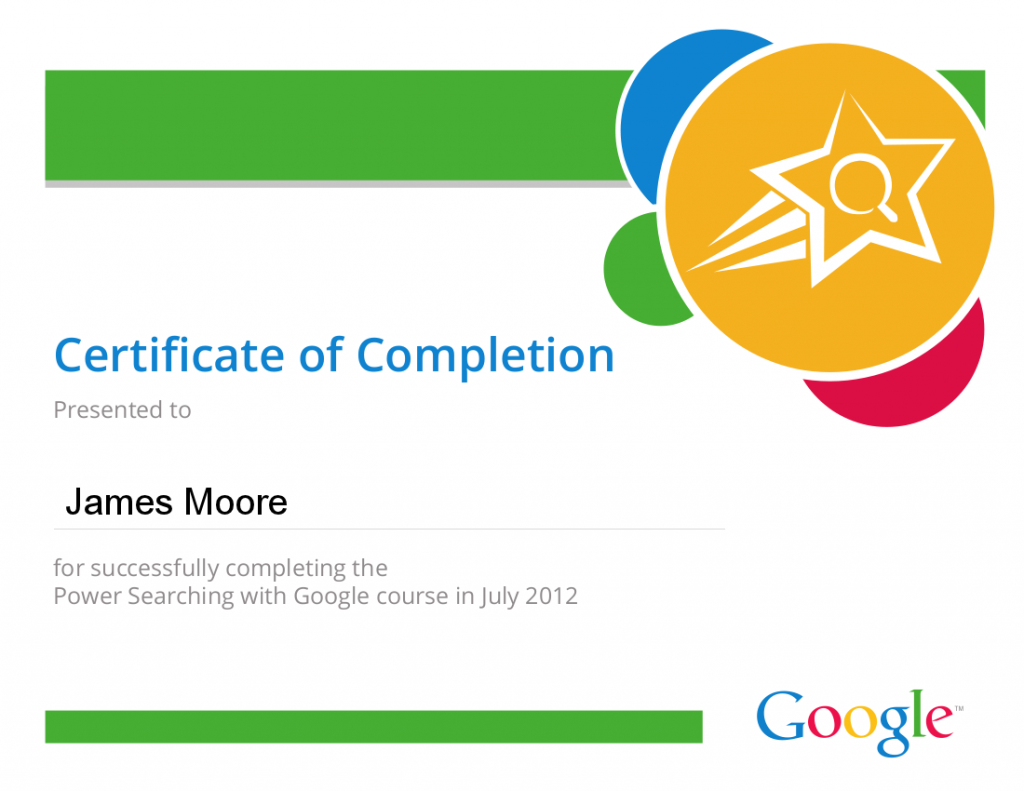
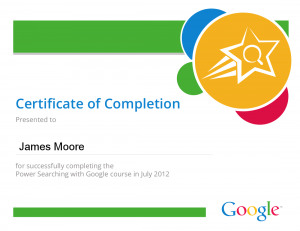
I received my certificate for successfully completing the “Power Searching with Google” online course. I decided to upload to the site rather than following Google’s suggestion to print out the certificate and affix to my wall.

I was impressed with what Google put together. Essentially this was a MOOC (Massive Open Online Course) with short video presentations/tutorials immediately followed by short exercises to demonstrate learning. The element that I found less impressive was the use of Google Groups discussion boards – meaningful conversation was drowned out by the sheer number of participants. However, this criticism is endemic to MOOCS.

Also, Google did a great job at transcribing the videos. In some ways the written elements are an easier method to learn. Printing these out (or viewing them on a second screen) whilst watching the videos was a good way to learn.

Found Interest in Pinterest

Pinterest

Tom Jacobs at DePaul shared an article with me yesterday that genuinely made me interested in actually using Pinterest. I scavenged an account early when the service was launched, but saw little reason to use it. However, a blogpost (A researcher’s survival guide to information overload and curation tools) on LSE’s website has given me pause to reconsider.

I think I will give it a go now, perhaps spending a week or two to see if the concept grows on me.

The article also shares some other social media tools. Definitely worth reading.

Instagram: A Half-Year Resolution

The Power of Habit

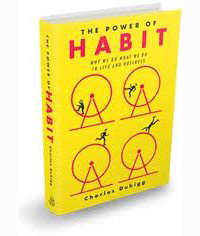
I recently finished reading Charles Duhigg’s rather excellent book “The Power of Habit.” The book explores why habits form, and what can be done to change them. It is a very entertaining and interesting read. Reading the book, I started to think about some of my habits – which ones I wanted to change, which ones I could change, how one habit change might effect other habit changes.

One experiment that I have decided to begin is taking a daily photograph. The plan from here on is to take one photograph a day, and then post it to the Internet. Instagram is the weapon of choice here, and I will see how taking that picture changes other habits and behavior. The pictures should show up on the site here, but they will also appear on:

Power Searching With Google

Google Power Search

Google Power Search

I have signed up for the “Power Searching With Google” course that starts in July. I am very interested in seeing what is covered, and the types of people who will sign up. The cynical part of me assumes that there will be a significant SEO / Internet Marketing presence (looking for ways to optimize their organic search listings), rather than ordinary folks looking to search smarter/quicker/better. Anyway, my understanding so far is that the course officially launches on the 10th July, with a series of one-hour asynchronous sessions:

  • Class 1 available: July 10
  • Class 2 available: July 11
  • Class 3 available: July 12
  • Hangout on Air with search experts: July 13 3:00-3:45pm Central Time
  • Mid-class assessment due: July 17 at 9:59am Central Time
  • Class 4 available: July 17
  • Class 5 available: July 18
  • Class 6 available: July 19
  • Hangout on Air with search experts: July 19 1:00-1:45pm Central Time
  • Final assessment due: July 23 at 6:59pm Central Time