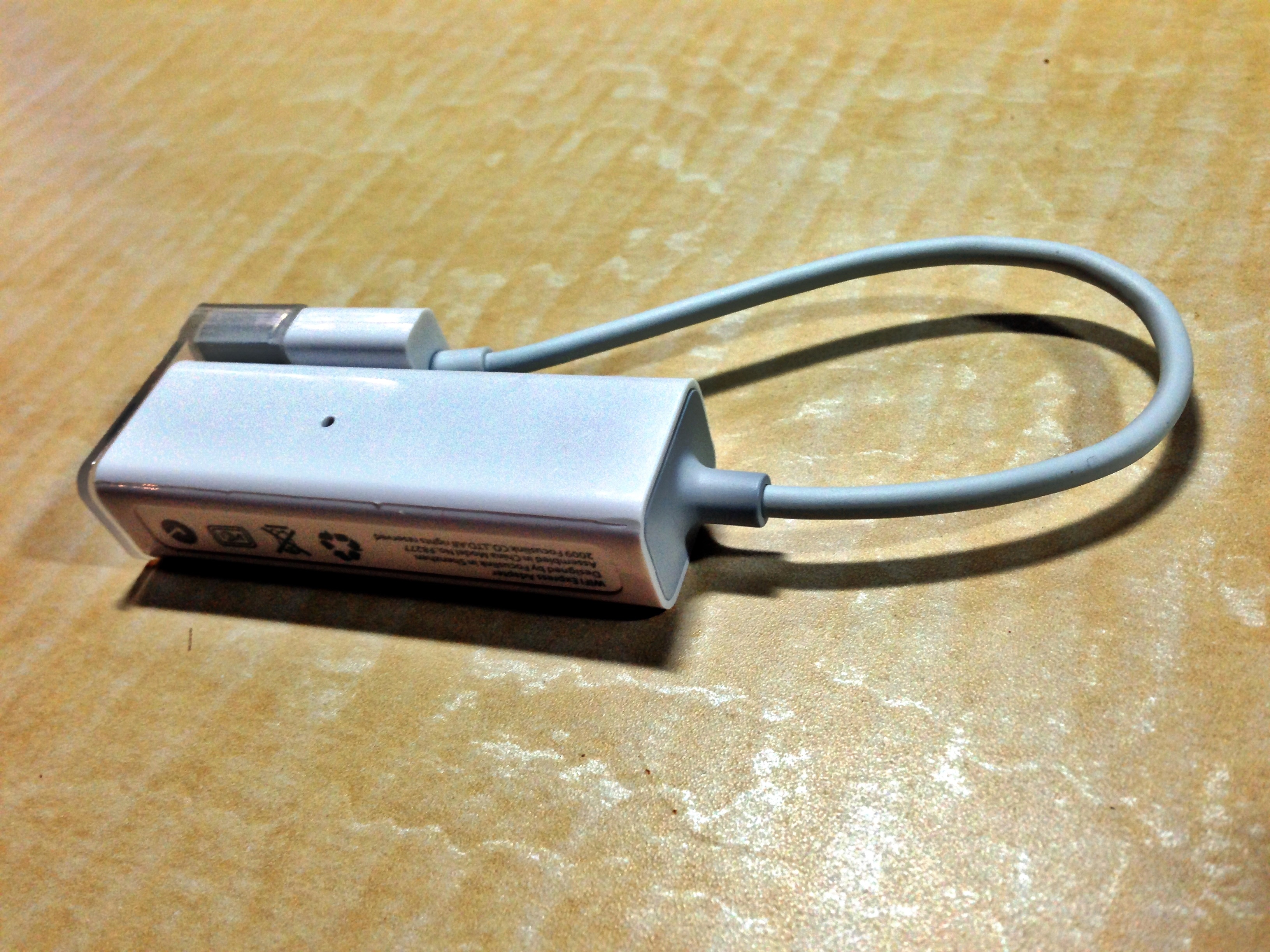
I migrated to an Apple iPhone 5 a while back. Even though the ‘phone is lacking a keyboard (which my old Nokia N900 had) I am fairly happy with the device. However, I sort of need for a portable speaker, and rather than buy a Jawbone JAMBOX (or equivalent) I think I can repurpose the N900.
#!/bin/sh
amixer -c0 set PCM 100%
amixer -c0 set 'Right PGA Bypass Mixer HP Switc' on
amixer -c0 set 'Left PGA Bypass Mixer HP' on
amixer -c0 set 'Left PGA Mixer Line1L' on
amixer -c0 set 'Left PGA Mixer Line2L' on
amixer -c0 set 'HP PGA Bypass' 100%
amixer -c0 set 'Speaker Function' On
echo "Speaker is ON"
Speaker OFF
#!/bin/sh
amixer -c0 set PCM 100%
amixer -c0 set 'Right PGA Bypass Mixer HP Switc' off
amixer -c0 set 'Left PGA Bypass Mixer HP' off
amixer -c0 set 'Left PGA Mixer Line1L' off
amixer -c0 set 'Left PGA Mixer Line2L' off
amixer -c0 set 'HP PGA Bypass' 0%
echo "Speaker is OFF"
Some colleagues at work were sharing this article in the New York Times (California Bill Seeks Campus Credit for Online Study). The article is worth a careful read – California is the place to watch, and this could be a turning point in the acceptance of some MOOCs.
The Coursera MOOC I was taking (Fundamentals of Online Education) was recently cancelled. The reasons behind this (and the way in which the course was cancelled) have been instructive. I believe that this particular moment will feature heavily in future analysis of the MOOC movement.
On the 2nd February, I received this short email message from the instructor:
We want all students to have the highest quality learning experience. For this reason, we are temporarily suspending the “Fundamentals of Online Education: Planning and Application” course in order to make improvements. We apologize for any inconvenience that this may cause. We will inform you when the course will be reoffered.
Then I received this email update the next day:
Dear FOE students,
We were inspired to see the number of people who expressed an interest in seeing the class resume. There were some choices made in the initial design of the class that didn’t work out as well as we’d hoped. We are working to address these issues, and are reopening the discussion forums so that we can get feedback on how the class can be improved when it relaunches.
Thank you for your patience as we work to provide you with a great learning experience in the next version.
The FOE Course Staff
Fundamentals of Online Education: Planning and Application Course Team
I don’t believe either of those emails were honest. The messages did not accept the three major problems that this particular course had:
The course was still under construction at time of launch.
The group model was both poorly designed and implemented.
There was no Quality Assurance in place before the course was offered.
The course was still under construction at time of launch
The first issue was inexcusable, particularly given the subject matter of the course. One of the fundamental tenets of good online course design is to have everything built before a course goes live. This does not preclude alterations and improvements (where justified) as a course is being taught, but this particular course still had “insert text here” content in the “About” pages. Going forward, Coursera needs to institute processes that ensure a course is ready before it launches.
The group model was both poorly designed and implemented
The second issue was interesting on several levels. The stated reason for assigning groups for students in the course was:
to make the discussions more manageable and to allow you to form networks with people in your own field and even with others not in your field. The idea was to create a world wide network of people who can help each other and to start building a world wide online learning community that will provide support and help.
However, MOOCs exhibit a significant attrition rate. In the first Coursera course I took these statistics were shared:
Number of students signed up: 45572
Number of students completing week 1: 1164
Number of students who took the Final: 5401
Number of certificates: 4595
To my mind, group membership would be significantly reduced by the end of the course (unless being part of the group successfully induced the majority of students to complete the course). I did not see this particular group model working. The instructor’s point about MOOC discussion being unmanageable is correct, and this is something that needs to be fixed, but the group method she implemented was not a viable solution.
Additionally, the methods in which students added themselves to groups were flawed. Initially this was through Google Docs, which does not scale to thousands of students (and resulted in records being deleted either inadvertently or to cause trouble). The later method was via discussion boards, in a way that was both inefficient and confusing. In neither option was there a way for students or Coursera to plan the composition of a group based upon any criteria (i.e. mixed skill-set, learning style, location, primary language, etc.). Hopefully the instructional designers and developers at Coursera will look for a method in which the course technology can automatically assign groups in an intelligent fashion. This would be an opportunity to run some very interesting and productive research.
There was no Quality Assurance in place before the course was offered.
Lastly, I did not see any indication of Quality Assurance being run in this course. If there had been a process in place that that reviewed the course before launch, then this would have caught that fact that the course was still under construction, and this should have also highlighted problems with the groups model. This is a major issue for Coursera to address. Oversight needs to be in place to demonstrate that a MOOC offers a superlative educational experience to students. The publishing industry relies on editors, proof-readers, legal review, designers, and peer assessment to ensure that what reaches the reader is a quality product. A MOOC should be have the same level of oversight as a good publishing house.
UPDATE: Interesting commentary from Slate on the “course meltdown.” Worth searching on Twitter for #foemooc
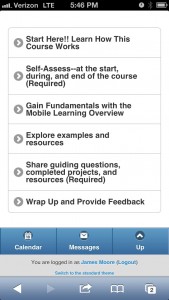
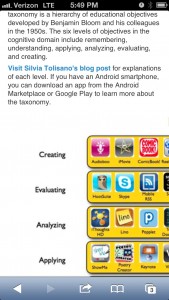
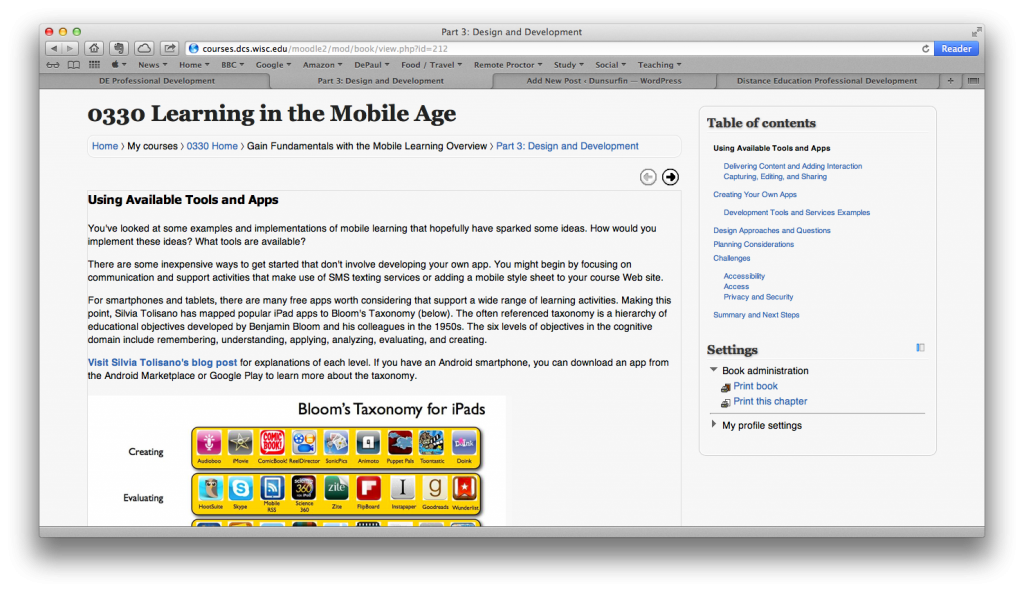
I have consciously attempted to study on a plethora of mobile devices (iPhone 5, iPad 3, Nokia N900, and Apple MacBook Air). The experience has been pleasant, and I have been impressed by how well the Moodle site has rendered on mobile devices. In some ways the navigational process has been more pleasant on an iPhone, where much of the structure has been abstracted. The only times I have wanted to return to using a laptop (which is still a mobile device) have been where images were difficult to view on the phone, or now, when I needed to type something up that was more than a few paragraphs in length.
Larger Images Did Not Work So Well On A Mobile Device
The resources that have been particularly useful to me in this course were in Part 3 (Design and Development), where a list of applications and ideas were listed for mobile student activity. Some of these I was already using, but others will be explored. These resources will be used in the classes I teach, and shared with my colleagues at work.
Part 3: Design and Development
I liked how various “chapters” of the courses could be collated and printed as a PDF. This will allow me to explore these resources after the course had finished, but my ideal situation would have been to save everything as an ebook (epub or ibook).
The course has introduced the concept of a guiding question, defined here as:
“A guiding question is the fundamental query that directs the search for understanding.” (Traver, 1998, p. 70)
My guiding question is one I have pondered for a while – how should one communicate with online students? Essentially I am looking for the ideal delivery platform for instructional materials that lasts beyond the course. A Learning Management System is a powerful platform, but once a course is over students no longer have access to the contents. Communicating over the Internet is efficient and extensible, but students do not always have continuous access to the Internet. I need something that works beyond these limitations.
I think my guiding question is still relevant based upon the ideas and material I have encountered in the course. In some ways this has become more relevant, as during the course I experienced times in which I wanted to study but did not have Internet access. An ideal platform for study would have (perhaps) been something analogous to a service like EverNote, which provides a local copy of resources on digital device, but syncs when connected to the Internet.
The guiding question will continue beyond the life of the course, but the course has introduced new tools and perspectives that will help me approach a workable solution to the problem.
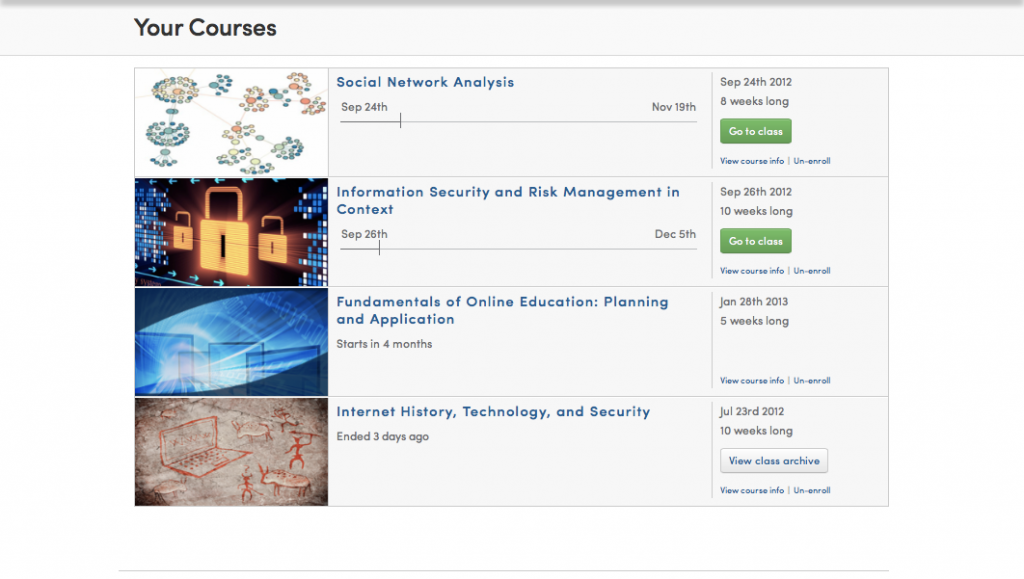
So far I have taken three MOOCs, and I am currently taking another two (and I am enrolled in a Udacity course that I believe is study at your own pace – Introduction to Computer Science CS101, which I will look at way later in the year):
Information Security and Risk Management in Context
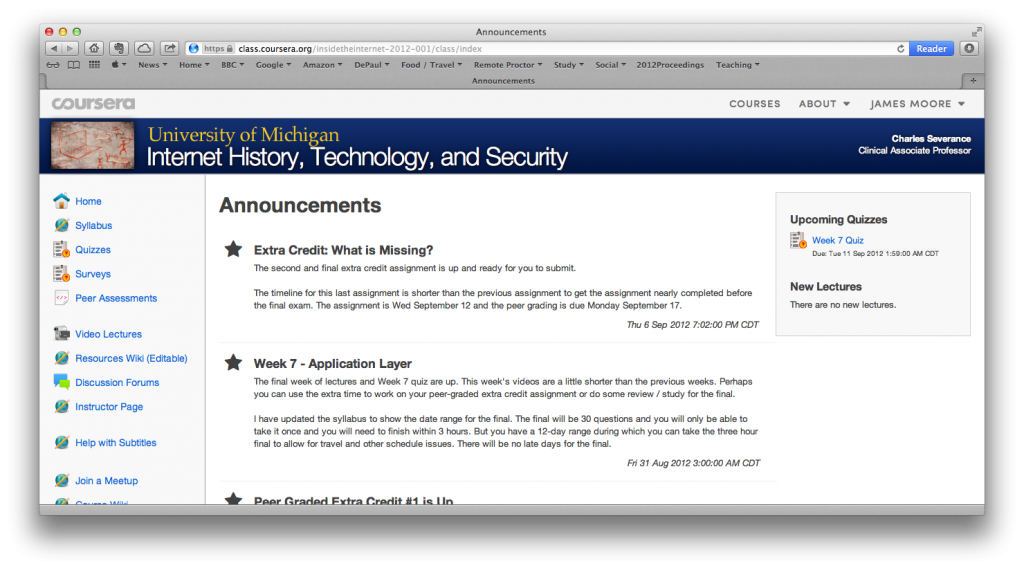
The instructor (Charles Severance) has been very good at communicating with students since the course has officially ended. There have been several email updates sent out to the group alerting us to the certificate status. This is good in of itself, but what is even better is that he recorded a “reflection / summary lecture” which he had planned to:
“talk about how the class went, what worked and how I would improve the class, and share some of the data about the class with you”
This is fantastic, and demonstrates what I find most powerful about the MOOCs – the way in which the large number of students combine with the open nature of the MOOC philosophy to rapidly iterate improvements (providing faculty, instructional designers, technologists, etc. are willing and prepared to make changes).
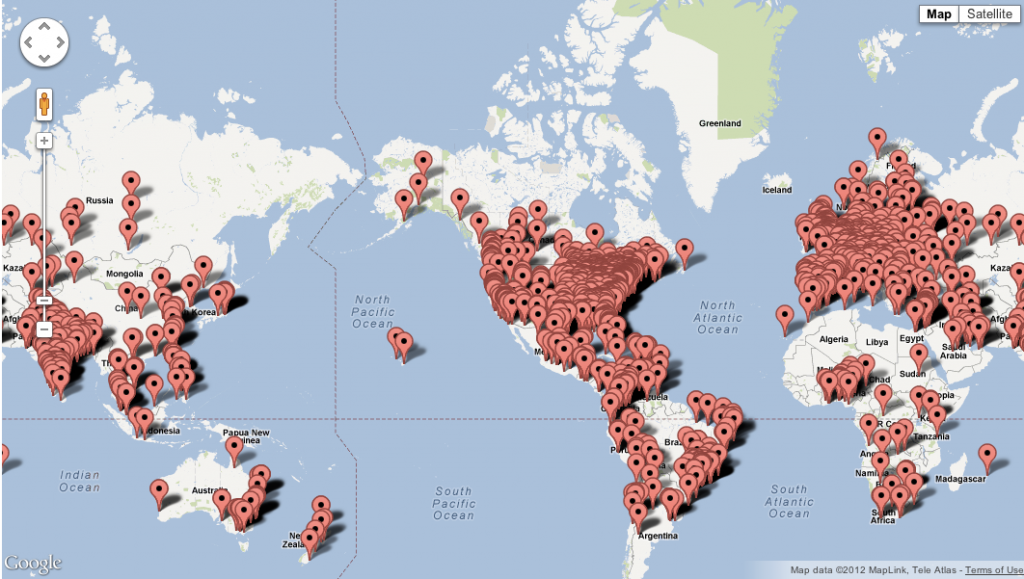
Data on where the Coursera students came from
Chuck shared some data on where the students came from, which can be seen by following this link to Google Maps.
The reflection video shared some great data on the student population, but this data I found particularly interesting:
Number of students signed up: 45572
Number of students completing week 1: 1164
Number of students who took the Final: 5401
Number of certificates: 4595
Chuck then shared his thoughts on what went well, and what he would do differently. I don’t think he will mind me repeating this here given his adherance to openness and transparency:
Worked Well
Using Twitter as the way to contact me
Discussion tool is outstanding
Multi-take quizzes with automorphing questions
Lecture video format with me looking at the Cintiq
Discussion forums and their voting
Cognitive load from the forums to me was manageable
Mail to the class needed to come from me
Office hours as small focus groups to help me improve the course
Things He Would Do Differently
Better Welcome Lecture
How to use the software lecture from Coursera (i.e. like resources)
How and when to use the “flag” icon
How do Late Days work?????
Describe community communication guidelines – when we will delete a thread
Delete threads more often
Faster lecture translating
All writing assignments are extra credit (because this is an intro class)
I still don’t get reputation points and how I should use them
More student editable spaces
Better way to identify natural leaders in the community and give them ways to communicate broadly other than “+1 votes” in the discussion
Split lectures at week boundaries (oops)
Add a “breath/pause” during lecture recording to allow me to later decide where to put a question.
Come up with an extensive preview so people don’t register just to peek
Tell late entrants that after week 3 they will not likely get a certificate – perhaps even close registration – you can go on a wait list and see the materials but not take the quizzes
I would like to come up with a selfpaced version – but the software would need to be different
This really gets to why the course was so successful – a professor who felt passionate about making improvements to the course as it was being taught, and then applying longer-term changes for the future. He also was extremely approachable using Twitter, the discussion boards, and traveling office hours to communicate.
I was lucky enough to participate in the Chicago office hours, and found this to give me more of a connection to the course.
It gets even better – Chuck is intending to build a sequence of MOOC courses that build upon each other, and he is personally signing all certificates sent to him.
It has been a definite pleasure taking the course.
Social Network Analysis
This looks to be the more “hands-on” of the various MOOCs, with applications to install and data to process. I have some assignments to complete and need to dig in deeper. I am happy with the way the course is going, and know that this will stretch me.
Information Security and Risk Management in Context
There has been an undercurrent (and sometimes more than that) of dissatisfaction in the discussion boards the past week. The areas that several of my fellow students feel less than happy are:
Announcements that the videos cannot be downloaded.
Reuse of older classroom videos.
Promotion of the certificate programs ($1,025 for noncredit or $2,055 for graduate credit). Here the wording and frequency of this information seems to have rubbed people the wrong way.
A feeling that the course was rushed to meet a deadline, rather than waiting to release something more polished later in the year.
These are all fixable issues, and this is the first time this course has been taught, so it will be interesting to see what approaches are taken to meet these student comments.
This is the first Coursera course where textbooks have been required/recommended. What I think would have worked better here would have been:
Selecting entirely digital required reading (rather than having to find and order a physical book).
Providing the required/recommended reading information earlier in the course.
However, I am finding the content in this course particularly relevant to my interests, and look forward to future weeks.
After posting (yesterday) about the Coursera Social Network Analysis MOOC I received a form email that impressed me. It looks like the Coursera staff are monitoring the Web for conversation about this particular MOOC. The email was well crafted and balanced, conveying respect for those who wanted to blog about the course but reminding students of the honour code.
To summarize the email:
Posting solutions to quiz problems is not allowed.
Sharing experiences, ideas, and examples that go beyond the assignments is allowed.
Sharing/discussing assignments after the deadline is allowed, but this should not take place publicly (i.e. on a blog)
The email concluded with a reminder of the Coursera honor code:
My answers to homework, quizzes and exams will be my own work (except for assignments that explicitly permit collaboration).
I will not make solutions to homework, quizzes or exams available to anyone else. This includes both solutions written by me, as well as any official solutions provided by the course staff.
I will not engage in any other activities that will dishonestly improve my results or dishonestly improve/hurt the results of others.
I was impressed that Coursera is actively communicating and reinforcing the honor code. I have noticed that for other/older Coursera courses that some students have posted old quiz questions and possible solutions. Hopefully the reminder emails will limit the sharing of assignment information.
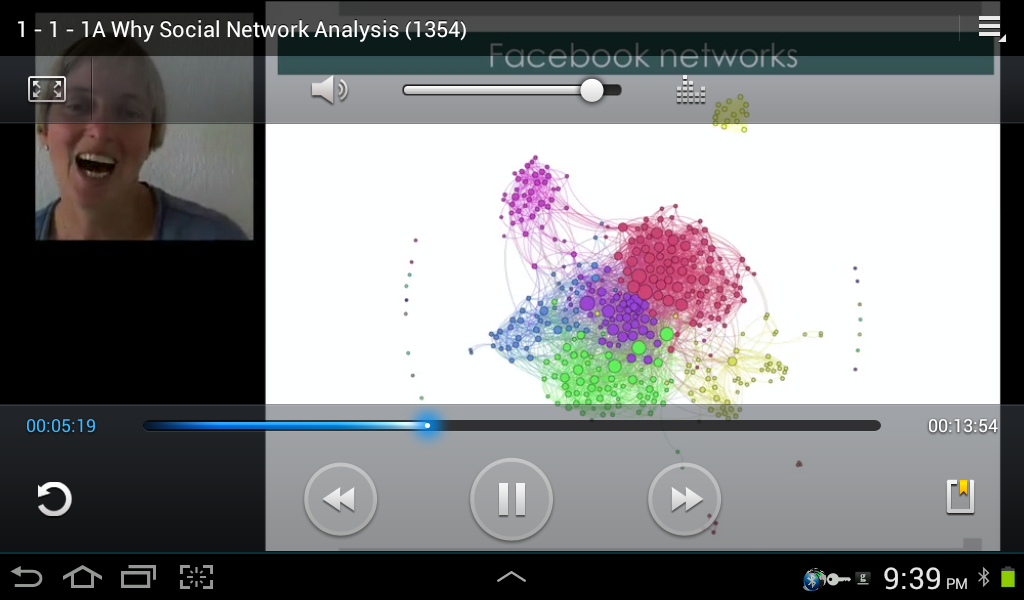
I am watching the Week 1 videos as I travel too and from work. Being able to download the videos to a tablet, and then watching them on the El has been very helpful. In my last course the instructor positioned the camera in such a way to capture footage of him working with a Wacom Cintiq display and splitscreen the results with Camtasia (on the Mac). This instructor is using a splitscreen that mixes PowerPoint slides with a talking head – the downside of this is sometimes the experience is akin to the “uncanny valley,” the instructors eyes and attention is directed away from the camera (towards off-camera notes) and the communication does not work as well. But when you get the “direct eye contact” the presentation comes across particularly well, and the instructors passion for the subject makes the topic come alive.
I definitely get the opinion that the Coursera MOOCs (and maybe all MOOC in general) are faculty-driven. The faculty are doing this because they love the topics and the idea of open education.
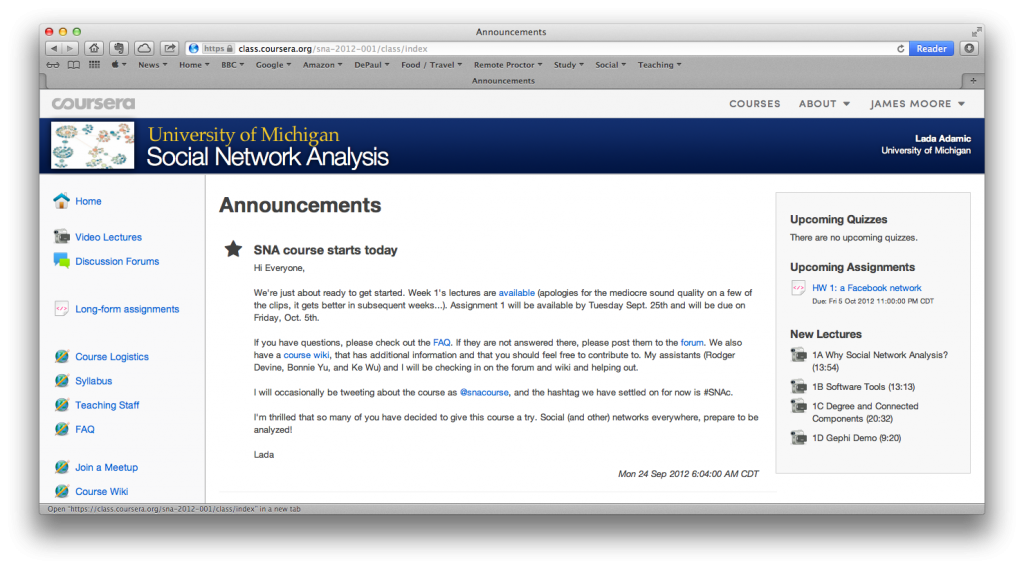
Just started my second Coursera MOOC (Social Network Analysis). Very interesting to notice the changes and improvements going forward. Coursera is now sending an updated email alert when the course is about to start:
Today’s the first day of Social Network Analysis. Here’s checklist to help you get started:
✔ Log in to the course and review the syllabus
✔ Watch the first lecture
✔ Go to the forum and introduce yourself (i.e. Hi! My name is Gustavo and
I’m from San Francisco.) Don’t worry, they won’t bite!
✔ Schedule a time to watch the video lectures and do the assignments
each week
✔ Visit meetup.com/coursera to see if there’s a in-person meetup
happening in your area
✔ Fill out your profile (if you haven’t already!)
✔ Have fun!
Let the learning begin!
Your Coursera Team
Logging into the course for the first time, students are now presented with these honour code statements:
In order to ensure fairness, all students participating in any of our online classes must agree to abide by the following code of conduct:
I will register for only one account.
My answers to homework, quizzes and exams will be my own work (except for assignments that explicitly permit collaboration).
I will not make solutions to homework, quizzes or exams available to anyone else. This includes both solutions written by me, as well as any official solutions provided by the course staff.
I will not engage in any other activities that will dishonestly improve my results or dishonestly improve/hurt the results of others.
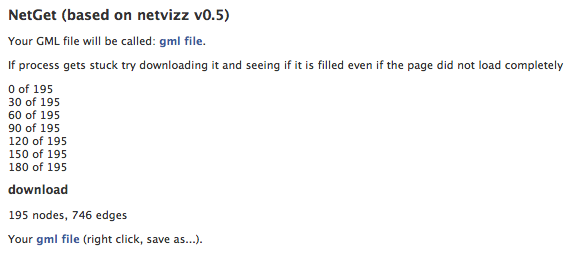
The first assignment looks very interesting, and involves downloading data from my Facebook network (195 contacts) and loading this into Gephi. Looking forward into how things progress.
One of my initial observations is how the grading policy for this course is markedly different to the previous one. I don’t know how much direction Coursera provides to faculty. Policy is as follows:
Grading scheme non-programming option 8 homework assignments are worth 10 points each. The 7 highest scores will be counted toward 70% of the grade (i.e. I will be dropping the lowest score from your assignments) . The final exam (multiple choice + short answer) counts for 30% of the final grade. A certificate will be issued to those achieving 80%+ of the total points possible.
programming option If you select this option, in addition to the regular assignments there will be ~4 programming assignments, the last of which will be a an independent mini-project to be peer-evaluated. The projects can optionally be submitted to the forum. Those voted up by the community will be featured and discussed in a Google Hangout session.
Late policy
I realize that many of you are leading busy lives and may not always be able to meet the deadlines. You can always skip one of the assignments (only the top 7 will be counted). You also have an allocation of late days (8 in total). If you don’t allocate late days, the assignment will be marked down 10%/day. These lenient policies are meant to encourage you to submit work throughout the course without stressing too much about deadlines.
Also, there are four teaching staff rather than one in my previous course. I wonder if this is a model Coursera is moving towards, or if this was just a decision for this course and the nature of the assignments.
One thing of particular note with the Coursera videos, is that they provide subtitles as a standard. The FAQs indicate that the primary focus here is for students where English is not their first language, not students with disabilities.
I am in the final weeks of a Cousera course (Internet History, Technology, and Security), and the instructor has kindly shared the demographic data provided (via a survey) for the students in the MOOC. As Charles Severance says:
Of course the caveat is that it is not scientific, it is partial, incomplete, your results may vary, void where prohibited, etc etc etc. It is anecdotal at best but certainly interesting. This is not all the data but the other items like country need some coding as they were fill-in-the-blank and folks filled it in a lot of ways.
Is this your first online class?
1611 Yes
1942 No
Is this your first large, free, online course (i.e. MOOC)?
2232 Yes
1319 No
Which best describes your motivation for taking this class? Check all that apply:
2677 General interest in the topic
2215 Extending current knowledge of the topic
442 Supplement other college/university classes courses
203 Decide if I want to take college/university classes on the topic
1539 Professional development
1437 Interest in how these courses are taught
Are you currently a student in a school or college?
972 Yes
2572 No
What is your highest level of education?
81 Some high school
298 High school
363 Some college
207 Associate’s degree (2 years of college)
1234 Bachelor’s degree (BA/BS, 4 years of college)
1016 Master’s degree
186 Doctoral degree
174 Professional degree (MD, JD)
Are you currently a teacher?
451 Yes
3088 No
If you are a teacher, are you thinking about reusing some of the material in this course for your own course?
The Chronicle of Higher Education has a balanced and short piece about MOOCs (What You Need to Know About MOOC’s). Well worth reading if you are unsure what all the fuss is about (thanks to Curt Bonk and GiamMario Besana for the link).
I would disagree with the line “with minimal involvement by professors” – I would not say that involvement is minimal, just that one-to-one interaction will be rare given the sheer number of students.
If reading the the CoHE piece, I would recommend going here after: